.png?width=544&height=70&name=Layer_1%20(5).png)


In a significant announcement, Meta CEO Mark Zuckerberg has outlined sweeping changes to the...

Every industry faces reputation risk. But pharmaceutical companies face a version of that risk that's structurally different—and far more challenging—than what other sectors experience.
When a tech company faces a crisis, they're responding to what happened. When a pharmaceutical company faces a crisis, they're responding to what happened plus accumulated public perception on the industry itself, a uniquely personal product category, and an organized opposition with economic incentives to see them fail.
Understanding these structural differences isn't academic—it's the foundation of any effective narrative defense. Here are six vulnerabilities that make pharmaceutical companies fundamentally different from other targets.
1. You Face a Pre-Loaded Narrative Frame
Most companies enter a crisis at neutral. The public hears about a problem and evaluates the specific situation. Pharmaceutical companies face a different starting point: inherited skepticism that exists before any specific event occurs.
Public perception of the pharmaceutical industry creates a headwind that individual companies must navigate—regardless of their own track record. When new stories emerge, they tend to be interpreted through existing frameworks that assume the worst. This isn't necessarily fair to any individual company, but it's the reality that communications teams must account for.
Historical industry events, from pricing controversies to safety incidents, have created templates that any pharma story can be pressed into. When critics frame a narrative using familiar language, they're activating pre-existing assumptions that audiences bring to the conversation.
- What this means: Your communications must clear a higher credibility bar than other industries face. Your strategy should account for this reality—not by ignoring it, but by understanding that building trust requires more deliberate effort than companies in other sectors typically need.
2. You're Asking People to Put Things in Their Bodies
No other industry operates with this fundamental trust requirement. When someone buys software, a car, or financial services, they can evaluate the product based on experience, reviews, and observable outcomes. When they take a medication, the stakes are much higher, and the risk-appetite much lower, by definition.
This creates an asymmetric vulnerability that's unique to healthcare: one scary story can outweigh a thousand reassuring studies. Fear about what's inside your body operates on a completely different psychological register than concerns about other purchase decisions. People don't have nightmares about their choice of laptop manufacturer. They do have nightmares about medications.
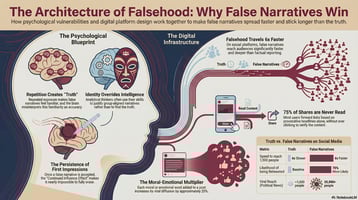
Research confirms this: patients with higher baseline medical caution are significantly more likely to believe unverified health claims when they encounter it. The fear response activates before rational evaluation can occur. This is why negative health narratives spread faster and stick harder than positive messaging, despite overwhelming scientific evidence—emotion operates faster than logic, and bodily fear is among the most powerful emotions.
- What this means: Pharma communications must respect this emotional reality rather than assume facts will win. Leading with data against an emotional concern often backfires—it signals that you're not hearing the underlying fear. Your first job is acknowledging the legitimacy of the concern, even when the specific claim triggering it can be explained or refuted through data. Only then can you introduce evidence effectively.
3. Every Drug's Side Effect Profile Is an Attack Surface
Here's something unique to pharma: your own approved labeling contains the ammunition for attacks against you.
Medication has known side effects. Clinical trials identify adverse events, regulatory agencies require disclosure, and this information becomes public. But this transparency creates a permanent vulnerability: any side effect can be isolated, amplified, and presented out of context. Attackers don't need to fabricate anything. They just need to cherry-pick real data and strip away the context of prevalence, severity, and risk-benefit tradeoff.
Attackers cherry-pick real safety data and strip away clinical context—prevalence, severity, risk-benefit tradeoffs. The result: misleading impressions built entirely from factual information.
This is increasingly weaponized. Studies show that roughly a third of popular social media articles about treatments contain misleading information—often by taking real safety data out of context. The same pattern repeats across therapeutic areas: real information, strategically decontextualized, creates false impressions without technically lying.
- What this means: Your monitoring needs to detect when legitimate safety information is being weaponized, not just when obviously false claims emerge. The most sophisticated attacks won't contain outright lies—they'll contain carefully selected truths. Defending against this requires understanding what parts of your safety profile are most vulnerable to decontextualization, and proactively providing context before attackers strip it away.
4. Patient Advocacy Language Gets Weaponized
Pharmaceutical companies should hear from patients. Legitimate patient concerns exist, and the industry benefits from listening carefully. But this legitimate function has been discovered by bad actors who have learned to mimic patient advocacy language to launder attacks.
"I'm just asking questions." "Patients deserve to know the truth." "Why won't they address these concerns?" These phrases can represent genuine patient engagement—or they can be the rhetorical signature of coordinated manipulation campaigns. The language of patient advocacy has become a vector for attacks precisely because it's so difficult to challenge without appearing to dismiss patients.
This creates a strategic trap. If you respond to manufactured "patient concerns" as if they're genuine, you legitimize the tactic and amplify the attack. If you dismiss them, you appear to be the callous corporation that critics always said you were. The attackers win either way—unless you can distinguish between the two (and that’s our job, at Vinesight).
Analysis of anti-pharma campaigns consistently reveals the pattern: accounts present themselves as concerned patients or parents, share "personal experiences" that align with specific negative narratives, and respond with outrage when questioned. In some therapeutic areas, a significant percentage of accounts driving negative narratives show markers of inauthenticity—but they're deliberately designed to look organic.
- What this means: You need the capability to distinguish authentic patient voice from manufactured controversy before deciding how to respond. This isn't about dismissing patient concerns—it's about ensuring your response resources go toward genuine engagement rather than feeding coordinated attacks. The analytical work must happen before the communications decision.
5. Narratives Form Fast—And Keep Evolving
Launch narratives set the initial frame for how a product is perceived. Journalists write their first stories. Patients form early impressions. Healthcare providers develop opinions they'll share for years. These initial frames matter—they shape all future coverage.
But narratives aren't static. They shift with new clinical data, competitor actions, regulatory developments, and emerging voices. A product that launches cleanly can face narrative challenges months or years later. A negative initial frame can sometimes be reshaped by sustained effort and new evidence.
This means threats can surface at any stage of a product's lifecycle—not just at launch. New patient communities form. Influencers discover topics. Competitors launch campaigns. Regulatory decisions reignite dormant debates. The narrative landscape is always shifting.
- What this means: Effective narrative defense requires both early detection and sustained monitoring as the story evolves. Launch matters, but so does the ongoing work of tracking how narratives develop, who's driving them, and where new threats are emerging. This isn't a launch-and-forget function—it's continuous.
6. Industry Attacks Affect Everyone
Past industry controversies didn't fade when the news cycle moved on. They created a permanent reservoir of public emotion that any pharma narrative can tap into—including narratives about your competitors.
When any pharmaceutical company faces criticism, it activates broader industry sentiment. Competitor crises don't stay contained—they raise scrutiny across the entire sector. A scandal at one company prompts journalists to ask whether similar issues exist elsewhere. Public frustration with one pricing decision becomes generalized skepticism about pharma pricing overall.
This creates a unique strategic reality: you need to monitor not just narratives about your own company, but narratives about your competitors and the industry as a whole. A crisis happening to someone else can quickly become your crisis when the public—or regulators—start looking for patterns.
- What this means: Your monitoring strategy must cover the full industry landscape, not just your own company. A competitor's crisis can become yours. Understanding what's happening across the sector gives you early warning when scrutiny might spread—and time to prepare your response before the questions arrive.
Taking Control of Your Narrative
These six vulnerabilities aren't problems to be solved—they're structural features of the pharmaceutical industry that any effective communications strategy must account for. They're also why generic "reputation management" approaches developed for other industries consistently fall short when applied to pharma.
Effective pharmaceutical narrative defense requires:
- Planning for higher scrutiny, rather than assuming credibility you may need to build
- Respecting emotional dynamics, especially around bodily safety, rather than leading with data alone
- Monitoring for weaponized context, not just false claims—your own safety data can be used against you
- Distinguishing authentic patient voice from manufactured outrage before deciding how to respond
- Defending launches with ongoing vigilance, not just initial monitoring
- Monitoring the full industry landscape—because a competitor's crisis can become yours
Pharmaceutical companies that understand these dynamics can build defenses that actually work. Those that apply generic playbooks will continue to be surprised when those playbooks fall short—not because they're bad playbooks, but because pharma plays by different rules.
Vinesight provides narrative intelligence for pharmaceutical and healthcare organizations. We detect emerging narrative threats across the full conversation landscape—including the spaces most monitoring tools miss.
Interested in learning how your brand can leverage emerging narrative and early attack detection ?