.png?width=544&height=70&name=Layer_1%20(5).png)

In a significant announcement, Meta CEO Mark Zuckerberg has outlined sweeping changes to the...
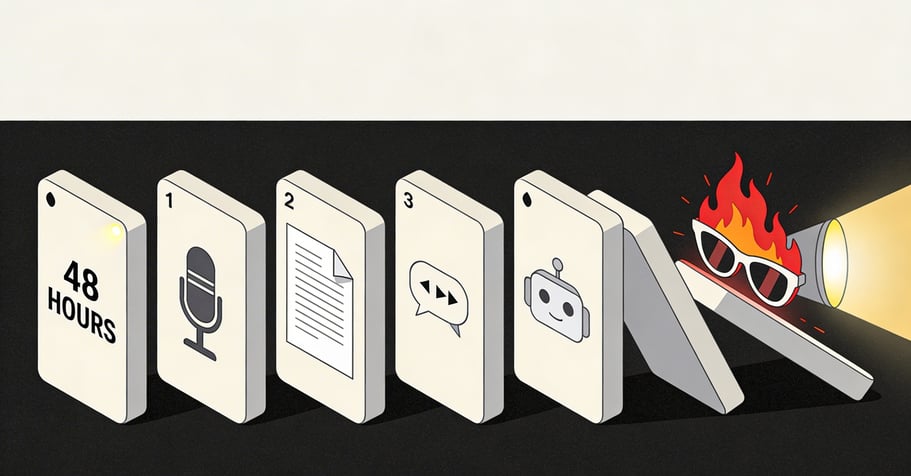
Part of our series: The Field Guide to Self-Destruction
Good news: you already have a crisis on your hands. Bad news: it's still manageable.
If you're tired of contained incidents that nobody remembers, this guide is for you. We studied the crises that turned from minor embarrassments into global spectacles in 2025, and reverse-engineered their techniques.
Follow these five steps, and your next reputational hiccup will be the one analysts cite for years (and that’s what you want).
1. Wait 48 Hours Before Saying Anything
Silence is golden — especially when the internet is filling it with speculation on your behalf.
A tech CEO was caught in an awkward personal moment at a live concert last year. Cameras, crowd, instant virality. Within hours, internet sleuths had identified everyone involved. Within a day, fabricated quotes attributed to the CEO were circulating — and actual news outlets were reporting them as real. The company first spoke two full days later. By then, it wasn't addressing an incident. It was playing defense against an entirely fictional narrative that had hardened into accepted fact.
The same year, a legacy automaker launched a controversial rebrand and watched the backlash unfold in real time. Their PR team stayed silent as the narrative cemented. By the time they engaged, the damage was structural: European sales eventually collapsed, the CEO stepped down, and the agency that designed the campaign was fired.
The lesson for aspiring crisis maximizers: every hour you stay quiet, someone else writes your story. And they're not careful with the facts. Give them a 48-hour head start and you'll spend weeks correcting a version of events you never authored.
2. Make Sure Your Response Sounds Like a Legal Filing
Your legal team exists to minimize liability. Your comms team exists to maintain trust. These are not the same objective — and 2025 proved what happens when you confuse them.
A major UK retailer hit by a ransomware attack initially responded brilliantly: the CEO communicated directly, in plain language, across multiple channels. Customers felt informed. The tone was human. Trust held. Then the updates slowed. When the full extent of a data breach emerged weeks later, the messaging had shifted to something more... lawyered. The warmth disappeared. What started as a masterclass quietly became a cautionary tale — the goodwill earned in week one was quietly spent by week four.
Meanwhile, a sports franchise facing rumors about one of its star players chose an aggressive, emotional rebuttal over standard crisis protocols. The response didn't kill the rumor — it confirmed that the organization was rattled, and inadvertently amplified the very story they were trying to suppress.
For maximum reputational damage, make sure every public statement sounds like it was drafted by someone billing by the hour. Nothing says "we care about you" like the soft touch of a lawyer.
3. Respond to Every Single Critic
When a negative post appears — any post, from anyone, on any platform — mobilize immediately. Issue a rebuttal. Tag your comms team. Set up a war room.
Never stop to ask: was this designed to provoke exactly this reaction?
In 2025, a coordinated smear campaign targeted a globally recognized public figure. The attacks were loud, widespread, and clearly intended to force a defensive response. Instead, the target's team quietly analyzed the coordination behind the campaign, determined it was manufactured — and said nothing. No statements. No engagement. No oxygen. The campaign faded.
Compare that to a British travel company whose advertising jingle was hijacked by millions of social media users, turning it into a global meme with over 80 billion views. The brand could have panicked. Instead, they leaned in — launching a lip-sync challenge, engaging creators, celebrating the absurdity. The result? Record passenger numbers that year.
But then something shifted. A government agency repurposed the same audio for a politically charged post. Suddenly the brand's cheerful jingle was soundtrack to something far more charged — and they hadn't done a thing. The lesson cuts both ways: sometimes the right response is to lean in, sometimes it's silence, and sometimes a crisis arrives that you didn't create and can't control.
The key is knowing which situation you're in. And you can't know that if your only move is to fire back at everything that moves.
4. Assume All Outrage Is Real
A backlash is a backlash. Who has time to check whether the angry accounts are actual customers?
Apparently, not enough brands. Across 2025's biggest corporate controversies, the numbers tell a consistent and uncomfortable story: in one major restaurant chain's rebrand backlash, analysis found over a fifth of participating profiles were fake — generating millions of views and contributing to a double-digit stock decline. The company reversed the rebrand.
The throughline is striking: in 2025, around 93% of bot activity in brand crises came from reposting existing content. The bots didn't create the outrage. They amplified it — turning what might have been a manageable moment of criticism into what looked like a movement.
The pro move for crisis maximizers: treat manufactured consensus exactly like real customer sentiment. Change your strategy to appease accounts that will never buy your product. Issue apologies to bots: They have feelings too.
5. Treat Your First Good Response as the Finish Line
You nailed the initial statement. The CEO was empathetic. The message was clear. Social media gave you a cautious thumbs-up.
Time to relax. Crisis over, right?
An airline that moved quickly to apologize after a massive data breach affecting millions of customers discovered that swift accountability wasn't enough. The incident "reopened old wounds" from earlier trust failures, precisely because the long-term follow-through had been missing for years.
Stakeholders don't just want to know you're aware of the problem. They want to know you're still working on it next Tuesday. And the Tuesday after that.
For guaranteed viral escalation, issue one strong statement and then ghost. The void you leave will be filled by speculation, conspiracy theories, and competitors who are only too happy to provide "context." Your silence will be interpreted not as composure, but as indifference. Or worse — as proof you have something to hide.
The Actual Takeaway
If you've read this far and thought "this sounds familiar," that's the point.
Every crisis that dominated headlines in the past year followed one of these patterns (usually more than one). And the landscape is only getting more complex: deepfake incidents targeting businesses surged nearly fourfold in the first half of 2025, with over 2,000 verified incidents in a single quarter and fraud losses exceeding $200 million. In one case, a coordinated deepfake campaign targeted some of a country's most prominent business leaders, and at least one victim transferred seven figures before realizing none of the "executives" on the call were real.
The brands that survived 2025 weren't luckier. They were more deliberate. They checked whether outrage was authentic before reacting to it. They communicated with speed and sustained it beyond the first news cycle. They understood that sometimes the most powerful response is no response at all. And they had the visibility to make these judgment calls in real time — not after the post-mortem, but during the window when the narrative was still forming.
Data is informative. But narratives are transformative.
The question isn't whether you'll face a crisis. It's whether you'll see it clearly enough to choose your response — or let someone else choose it for you.
Vinesight detects emerging narratives across mainstream and fringe platforms before they go viral — so you can act while you still have choices. Because the best crisis response starts before the crisis.
This is the second installment of The Field Guide to Self-Destruction, our series on strategic advice served backwards. Read the first: "5 Foolproof Ways to Ruin Your Reputation in 2026."
Interested in learning how your brand can leverage emerging narrative and early attack detection ?