.png?width=544&height=70&name=Layer_1%20(5).png)
When Silence Is Strategy

TL;DR
- When outrage is fake, slow-moving, and stuck in fringe corners of the internet, staying quiet is often the smartest move. A reply is itself a form of attention. It signals that the attack matters, feeds the algorithms that reward engagement, and can carry a fringe claim up into mainstream news.
- Silence is reckless, though, when the criticism is real, when it touches a genuine safety, legal, ethical, or factual issue, or when the people who matter to you already know about it and expect an answer. Decades of crisis research show that ignoring a legitimate problem makes the damage worse.
- The decision comes down to signals you can actually measure: how much of the conversation is driven by fake accounts (against a roughly 20% bot baseline on X), how fast it's spreading, whether it's jumping across platforms, whether credentialed mainstream voices have picked it up, and whether your real-world numbers (sales, foot traffic, support tickets) are moving.
Key Findings
- The main danger of responding is that you amplify the attack. A reply, rebuttal, or correction is still engagement, and platform algorithms push the content that gets the most engagement. So a response can hand a dying narrative exactly the boost it needed. The Taylor Swift case is the clearest recent example: a small cluster of coordinated accounts seeded a false "Nazi symbolism" story, and ordinary users, including fans trying to debunk it, spread it further simply by engaging with it.
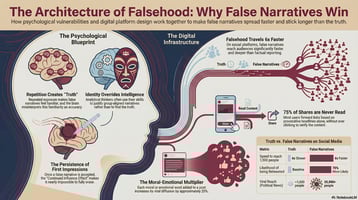
- Correcting a false claim usually works. The popular fear that corrections backfire and make people believe the lie more strongly turns out to be mostly a myth. There is a real but narrower problem, though: a false claim can keep shaping how people think even after they have seen it debunked, and repeating the claim in order to knock it down can make it stick in memory. Fact-check and move-on.
- Fake activity routinely makes a brand controversy look bigger than it is. But the headline percentages vary wildly, and many of them come from companies selling analytics, so treat any single number with caution.
- The research does not treat silence as a default. It is a deliberate, time-limited tactic that works only under specific conditions, and it fails badly when used to dodge or hide a real problem.
Details
Why staying silent can be the right call
What crisis communications research says. The leading framework, W. Timothy Coombs's Situational Crisis Communication Theory (SCCT, 2007), matches your response to how much blame the public assigns you. It sorts crises into three types (victim, accidental, and preventable) and recommends responses that scale with the threat, from simple denial up to a full effort to rebuild trust. Notably, staying silent is not one of SCCT's listed strategies, and it isn't in Benoit's image repair theory either. Later researchers argued that silence deserves to be treated as a real strategy in its own right. Le, Pang, and colleagues, studying eight international cases, identified three kinds of silence based on intent: delaying, avoiding, and hiding. Their finding matters for brands: a delaying silence can protect or even restore a reputation, as long as you hold it on purpose and then break it on your own terms. Avoiding and hiding silences do the opposite. They make a crisis worse and damage the brand once someone forces the silence open.
The Streisand effect. Coined by Mike Masnick in 2005, this is the classic amplification trap. In 2003, Barbra Streisand sued over an aerial photo of her Malibu home that had been downloaded just six times (twice by her own lawyers). The lawsuit drew more than 420,000 visitors to the site within months. The lesson for brands: a visible attempt to suppress or aggressively swat down low-profile content can manufacture the very attention you were trying to avoid.
Trading up the chain. Alice Marwick and Rebecca Lewis (Data & Society, 2017) and Ryan Holiday (Trust Me, I'm Lying, 2012) describe a deliberate tactic: plant a story in a fringe space like a 4chan board or a niche forum, then push it to slightly bigger outlets, then bigger ones still, until a fake claim ends up reported as fact. A brand's public response is often the bridge that carries a fringe claim up that chain. Responding to it tells the world it is worth covering.
The backfire myth, and the real problem underneath it. The "backfire effect" (Nyhan & Reifler, 2010) suggested that correcting a false claim could make committed believers cling to it even harder. Later work undercut that fear. A large replication study by Wood and Porter (2019), along with reviews that followed, found these belief-strengthening backfires are rare and hard to reproduce. Corrections generally nudge people toward the facts. The current scholarly consensus (Lewandowsky et al., 2020; Nyhan, 2021) is that backfire happens only in narrow circumstances. The more stubborn problem is something called the continued influence effect: a false claim keeps coloring how people reason even after they've seen a clear correction, and restating the claim in order to debunk it can make it feel more familiar, and therefore more believable. The practical takeaway is simple. If you respond, lead with the truth and don't give the false claim top billing.
When to choose silence: the decision factors
Pulling the research together, a deliberate silence is most defensible when all of these are true:
- The activity is fake. The conversation is driven mostly by coordinated or automated accounts, not real customers or stakeholders.
- It isn't spreading fast. The story is staying in fringe spaces and looks likely to fizzle out on its own if you don't feed it.
- Real reach is small. Few actual people are engaging, and the odds of mainstream pickup are low.
- Nothing serious is at stake. There's no genuine safety, legal, ethical, or factual problem behind the noise.
- It's bait. The campaign is built to provoke a reaction, because the reaction is what spreads it.
- The people who matter don't know. Key audiences/stakeholders aren't asking you about it or being exposed to it (requires audience analysis).
Silence becomes reckless the moment the criticism is real, serious, or coming from your actual stakeholders. Here the research flips. SCCT and the "stealing thunder" studies (Arpan and Roskos-Ewoldsen, 2005; reviewed by Claeys) show that getting ahead of a legitimate problem, by disclosing it yourself before someone else does, makes you look more credible, makes the problem seem less severe, and limits the reputational damage compared with letting a third party break the news.
Metrics to watch
- Share of fake versus real accounts. Carnegie Mellon researchers Lynnette Ng and Kathleen Carley (2025) find that chatter about global events on social media runs roughly 20% bots and 80% humans, and that spikes well above 20% suggest bot operators have taken an interest in the topic. That roughly matches the 20% figure Elon Musk cited in 2022. For overall prevalence, Varol, Ferrara, Davis, Menczer, and Flammini (ICWSM 2017) estimated that 9% to 15% of active Twitter accounts were bots, calling 15% a conservative figure. The rule of thumb: a controversy whose bot share runs well above 20% is an argument for restraint, not action.
- Concentration. How small a group is driving how much of the conversation. A handful of accounts producing a large share of the posts is a possible sign of coordination. Low engagement-to-reach (how much impressions, for instance, vs "likes") is also a good sign that a topic may be talked about by a vocal minority, but not necessarily gaining tractions among the larger share of accounts, on social media, who tend to be more passive in their consumption of the medium.
- Velocity and trajectory. How fast new posts are appearing, and whether that curve is climbing or already falling. Watch any metric that has to do with sharing (and thus spreading) content.
- Cross-platform spread. The same or near-identical wording showing up across several platforms at once is a coordination fingerprint.
- The fringe-to-mainstream jump. Have credentialed voices, such as journalists, verified accounts, or politicians, entered the conversation yet?
- Sentiment over time, and your real-world numbers. Track where sentiment is heading, but weight it against first-party signals: actual sales, foot traffic, and customer-service volume. These tell you whether the noise is touching your business at all.
Case studies
Taylor Swift (October 2025): stayed silent, and the attack faded. Around the release of The Life of a Showgirl, a coordinated network pushed false claims that Swift was using "Nazi symbolism" and right-wing dogwhistles. The provocations first surfaced on edgier forums like 4chan and Kiwi Farms, then moved onto mainstream apps. The behavioral-intelligence firm GUDEA, in a white paper titled "Taylor Swift: Anatomy of a Narrative" (shared first with Rolling Stone), studied more than 24,000 posts and 18,000 accounts across 14 platforms between October 4 and October 18. It found that just 3.77% of accounts drove 28% of the conversation about Swift and the album. GUDEA also found heavy overlap with an earlier campaign against actress Blake Lively, identifying 2,395 accounts active in both, which it called a "cross-event amplification network." As Rolling Stone summed up GUDEA's core point, getting real users to mock or refute an outlandish claim simply spreads it further, and the false story managed to pull ordinary users into Swift-versus-Kanye-West comparisons even though most of them never believed the original claim. Swift and her team did not engage the smear (her representative declined to comment), and the campaign ran its course and faded on its own. This is the textbook example of fake outrage meeting deliberate silence.
Cracker Barrel (August 2025): responded, and arguably overreacted. After a routine logo refresh dropped its "Old Timer" figure, the brand hit a fast social firestorm. Within days it reversed the logo, paused store remodels, and reshuffled communications around its leadership. The cost was real and largely human-driven: the share price fell more than 20% from the August 19 announcement (Newsweek), and according to Placer.ai, store traffic dropped 5.3% year over year the week of August 25 and around 10% across the first three weeks of September. On the September 17 earnings call, CFO Craig Pommells said traffic was down "approximately 8 percent" since August 19 and projected a similar decline for the next quarter. Critics argued the company reacted to social noise rather than its own data, a reminder that capitulating fast can validate a campaign that is at least partly manufactured, even when some genuine customer unhappiness exists underneath.
United Airlines Flight 3411 (April 2017): silence was the wrong call. When video of Dr. David Dao being violently dragged off an overbooked plane went viral, United delayed, then put out a tone-deaf statement that apologized only for the "overbook situation," followed by a leaked internal email calling the passenger "disruptive and belligerent." This is the opposite lesson. A real, severe, organically viral crisis demanded an immediate and accountable response. United's shares dropped sharply and the brand took lasting damage. Silence and corporate spin are disastrous when the grievance is genuine and the public can already see the evidence with their own eyes.
Vinesight delivers narrative intelligence at the scale of the internet: tracking the stories forming around your brand across 14+ platforms and 50+ languages, identifying toxic misleading and inauthentic narratives, and turning early signals into recommended actions before a narrative hardens.
Subscribe Here!
About Vinesight
Vinesight has developed an AI-driven platform that monitors emerging social narratives, and identifies, analyzes, and responds to toxic attacks targeting brands, public sector institutions, and causes. We work with the entities that are at-risk for such attacks, including, the world's largest pharmaceutical companies, and the world's most prominent financial firms. Vinesight empowers brands, campaigns, and organizations to protect their narratives and brand, while ensuring that authenticity prevails in the digital space.
Interested in learning how your brand can leverage emerging narrative and early attack detection ?