.png?width=544&height=70&name=Layer_1%20(5).png)

.png?height=200&name=shutterstock_2467403207%201%20(2).png)

In recent years major global banks have been facing increasingly sophisticated threats designed to...
“A lie can travel around the world and back again while the truth is lacing up its boots.”
— Widely attributed to Mark Twain after his death (i.e. likely not by Mark Twain)
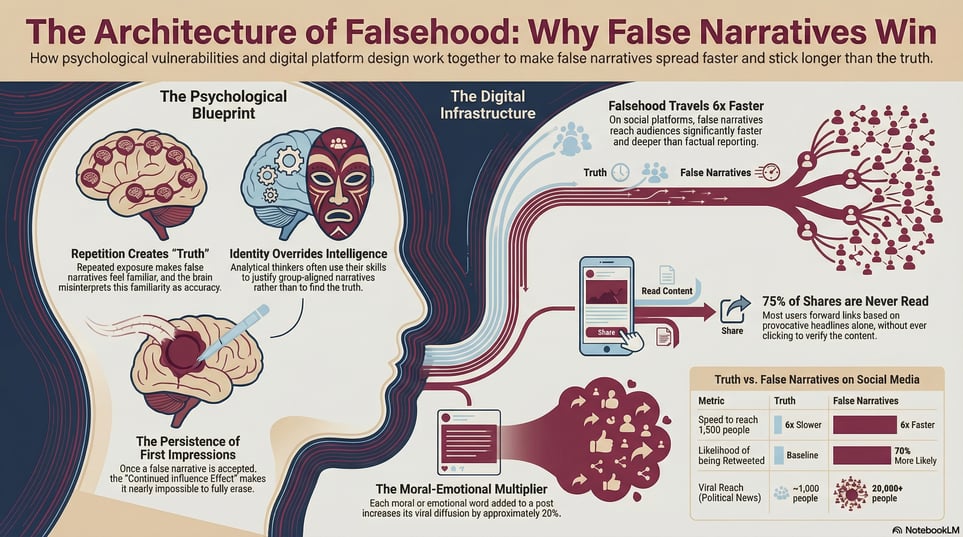
It turns out Mark Twain (or whoever uttered those words) was right — and today’s information and emotional ecosystem has given falsehood a jet engine. A landmark study by MIT researchers Soroush Vosoughi, Deb Roy, and Sinan Aral, published in Science in 2018, analyzed over 126,000 rumor cascades spread by roughly three million users on what was then Twitter. The results were striking: false stories were 70% more likely to be shared, and reached 1,500 people six times faster than accurate ones. The most viral false content was political, reaching audiences of over 20,000 people at roughly three times the speed of other categories.
Perhaps the most important finding: bots spread true and false content at equal rates. It was humans, not algorithms, who drove the outsized spread of falsehood. Subsequent analysis showed that false stories triggered fear, disgust, and surprise — high-arousal emotions that are precisely the ones most likely to compel sharing. In other words, while monitoring inauthentic behavior is critical, the information landscape is much larger and complex. Human psychology is a supercharger of false narratives.
What follows are six cognitive mechanisms — each well-documented in peer-reviewed research — that explain why our minds are so easily exploited by fabricated stories, and why traditional defenses consistently fall short.
1. The Autopilot Problem: We Share What We Never Read
People aren’t gullible. They’re distracted.
A 2016 study by researchers at Columbia University and INRIA, which tracked 2.8 million shares across major news domains, found that 59% of URLs shared on the platform were never clicked by the sharer. A larger-scale replication published in Nature Human Behaviour in January 2025 by S. Shyam Sundar and colleagues at Penn State — analyzing over 35 million public Facebook posts from 2017 to 2020 — found the problem had worsened: approximately 75% of forwarded links were shared without the user first clicking on them. This problem prompted platforms, such as X, to implement safeguards including by asking users whether they would like to read the article first, before posting.
The implication is profound. The vast majority of content that goes viral is judged entirely on its headline — or more accurately, on the emotional reaction the headline provokes. The circulation of news, and the engagement/attention economy favors speed over scrutiny. The share button is always closer than the url of the article itself.
Gordon Pennycook at Cornell University and David Rand at MIT have built a rigorous framework around this finding. Their research across multiple studies demonstrates that people share inaccurate content not because they believe it, but because accuracy simply never enters the decision process. In a Psychological Science study in 2020, they showed that a simple accuracy reminder — asking people to rate the truthfulness of a single headline — nearly tripled truth discernment in subsequent sharing decisions.
The problem isn’t that people can’t tell the difference between true and false. It’s that they’re never prompted to try.
2. First-Mover Advantage: The Narrative That Arrives First Wins
When we encounter information for the first time, it anchors our understanding of an event. Any subsequent correction doesn’t start from zero — it has to actively displace what’s already there. We are not computers replacing one value with another: Intuitively, anything that challenges an internalized “knowledge” challenges our world views.
Researchers call this the continued influence effect, and it was first demonstrated in a seminal 1994 study by Hollyn Johnson and Colleen Seifert at the University of Michigan. In their experiment, participants read about a warehouse fire where “volatile materials stored in a closet” were later identified as the cause. When that detail was subsequently retracted, over 90% of participants continued to reference it in follow-up reasoning tasks.
Stephan Lewandowsky at the University of Bristol has produced the most comprehensive body of work on this phenomenon. His 2012 review in Psychological Science in the Public Interest established that retractions rarely eliminate reliance on the original false claim, even when people believe, understand, and remember the correction. The most effective corrections don’t simply say “that was wrong” — they provide a causal alternative explanation to fill the gap left by the retracted narrative.
This is why speed matters so much in narrative defense. In a decentralized information landscape where anyone can publish and few verify, the first story to reach an audience anchors belief. Every correction that follows is fighting uphill against what the brain has already accepted as background knowledge. New information doesn’t feel like an update. It feels like an attack on what we already “know.”
3. The Repetition Trap: Familiar Feels True
Hearing something twice makes it feel more credible than hearing it once. This illusory truth effect was first identified in 1977 by Lynn Hasher, David Goldstein, and Thomas Toppino. In their experiment, college students rated repeated statements as significantly more valid than new ones across sessions spaced two weeks apart. A 2010 meta-analysis confirmed a medium effect size of d = 0.53, with the effect persisting whether repetitions occurred minutes or weeks apart.
The mechanism is processing fluency: information we’ve encountered before is easier to process, and our brains misattribute that ease to truthfulness. The most alarming modern finding came from Lisa Fazio at Vanderbilt University, who demonstrated in a 2015 Journal of Experimental Psychology study that the illusory truth effect persists even when participants already know the correct answer. Familiarity overrides knowledge.
Pennycook, Cannon, and Rand applied this directly to fabricated news headlines in 2018, finding that even a single prior exposure increased accuracy perceptions of false headlines. The effect was strong enough to essentially neutralize the benefit of fact-checking labels. And in a separate study, they discovered the implied truth effect: when warning labels are applied to some false content, unlabeled false content is perceived as more trustworthy than it would be without any labeling system at all.
4. The Emotion Engine: Outrage Is the Algorithm
Content laced with moral outrage, fear, or indignation spreads dramatically faster. The most precise quantification comes from William Brady, Jay Van Bavel, and colleagues at NYU, published in PNAS in 2017. Analyzing 563,312 social media posts across politically charged topics, they found that each additional moral-emotional word in a message increased its diffusion by approximately 20%. This “moral contagion” effect was bounded by group membership — emotional language amplified sharing within ideological networks but less between them.
Jonah Berger at Wharton demonstrated the underlying mechanism: it isn’t whether content is positive or negative that drives sharing, but whether it produces physiological arousal. High-arousal emotions, positive or negative (be it awe, anger, anxiety) were significantly more viral than low-arousal emotions like sadness, even after controlling for other variables.
Molly Crockett at Princeton provided the theoretical framework in a 2017 Nature Human Behaviour paper, demonstrating that immoral acts encountered online evoked significantly more outrage than those encountered in person or through traditional media. Digital platforms reduce the personal cost of expressing outrage while amplifying its social rewards, creating self-reinforcing cycles of escalating moral indignation. This is the engine that false narratives are designed to exploit.
5. The Identity Bypass & Polarization Reinforcing Loop
Another critical engine behind false narratives is polarization. Deeply polarized landscapes tend to affect our ability as “truth detectors”. In turn, we’re more likely to be polarized once our ability to detect (or even seek) the truth has eroded.
The evidence is unambiguous: ideology doesn't just shape what we believe — it reshapes how we reason. In a landmark 2019 study published in Social Psychological and Personality Science, researchers Anup Gampa, Sean Wojcik, and Peter Ditto presented liberals and conservatives with classically structured logical reasoning and found that both groups were significantly more likely to accept logically invalid arguments when the conclusion aligned with their worldview, and to reject logically valid arguments when it didn't. The effect held across three studies, over a thousand participants, and persisted even after training in formal logic. A Swedish nationally representative replication in 2022 confirmed the pattern across eight distinct political topics. As the original researchers put it: "Our biases drive us apart not only in our disagreements about political and ideological worldviews, but also in our understanding of logic itself."
It would be comforting to believe that education inoculates people against false narratives. The evidence says otherwise. Dan Kahan at Yale Law School found that the most scientifically literate and numerate citizens were not the most accurate in their beliefs about contested topics — they were the most polarized. His 2012 study in Nature Climate Change showed that as scientific competence increased, so did the gap between ideological groups.
Kahan calls this identity-protective cognition: the tendency to evaluate evidence through the lens of group identity rather than accuracy. When data conflicts with group beliefs, analytically skilled people don’t become better at finding truth — they become better at defending their existing worldview. Intelligence is weaponized for confirmation, not correction.
A 2024 meta-analysis from the Max Planck Institute for Human Development, encompassing over 256,000 choices across 31 experiments, delivered a striking confirmation: education had no significant impact on the ability to distinguish true from false news. Political identity was the strongest predictor. This is the polarization trap: the more divided a society becomes, the less effectively its members can evaluate information, which in turn deepens division further. It’s a vicious cycle that operates across every fault line — health, finance, geopolitics, climate.
6. The Gatekeeping Collapse: Speed Without Verification
The information landscape has undergone a structural transformation. Algorithms have replaced editorial judgment, optimizing for engagement rather than accuracy. The Reuters Institute Digital News Report — surveying roughly 95,000 respondents across 47 markets — found that global trust in news stands at just 40%, and that news avoidance has risen from 29% in 2017 to 39% in 2024.
The decentralization of information production has brought an enormous number of voices into the landscape. The pressure to be first — to break a story before competitors — consistently overrides the discipline to be right. Basic verification principles are abandoned under the weight of immediacy.
To be sure, previous gatekeeping could create different sets of biases (those of the gatekeepers themselves). But the new decentralized environment has also created an incentive to push information faster, as well as an expectation that said information can be easily digested without context. We live in a world where we expect information instantly, in digestible chunks. This creates an implicit assumption that all information looks like this: fast, simple, self-contained. We forget that there is always a mediator between us and the content we consume, always a context that would help us evaluate whether a claim deserves our trust. When context is stripped away (what researchers call “context collapse”) every piece of content arrives with equal apparent authority, whether it originates from a verified newsroom or an anonymous account.
The Architecture Is the Vulnerability
These six mechanisms don’t operate independently. They form an interlocking system. Emotional arousal drives the novelty and surprise responses that make false content travel faster than truth. Platform design encourages sharing without reading, meaning provocative headlines propagate without scrutiny. First exposure creates anchoring effects that corrections cannot fully undo, and repetition from viral spread manufactures perceived truth even for claims people know are false. Identity-protective cognition ensures that corrective information is filtered through group loyalty, while the collapse of editorial gatekeeping removes institutional checks that once caught errors before publication.
Three findings from this body of research reshape conventional wisdom. First, corrections do work — the much-feared “backfire effect” is far rarer than once believed. The real problem is that corrections decay over time while false narratives persist through repetition. Second, education alone does not protect against false belief; analytical skill can even deepen partisan bias. Third, most people spread inaccurate content not out of malice or ignorance, but because platform design never prompts them to consider accuracy.
This is precisely why the window for responding to emerging false narratives is so narrow. Once a story has been shared widely enough to trigger the repetition effect, anchored in early audiences through first-mover advantage, and amplified by emotional contagion through identity-based networks, the psychological architecture is working against any correction effort. The organizations that detect and understand these narrative dynamics early — while they still have options, not excuses — are the ones that maintain control of their own story.
About Vinesight
Vinesight provides narrative intelligence that helps organizations detect emerging threats to their reputation before they become crises. By monitoring fringe-to-mainstream narrative migration across 14+ platforms, Vinesight gives communications and security teams the decision window they need to respond while they still have options
Interested in learning how your brand can leverage emerging narrative and early attack detection ?
.png?height=200&name=shutterstock_2467403207%201%20(7).png)
